Half-plane Intersection
Compute the region that lies inside every half-plane of a set. That region is always a convex polygon (or empty / unbounded). We want its vertices.
This lesson follows CP-Algorithms — Half-plane intersection (Sort-and-Incremental, O(N log N)).
Prerequisites: points, vectors, line intersection, orientation (cross). Convex hull / CHT help intuition but are optional.
Definitions
N= number of half-planes.- Represent a half-plane by a point
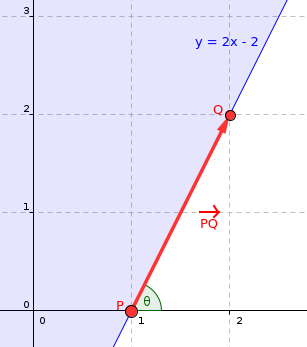
pon its boundary and direction vectorpq. The allowed region is to the left ofpq. The angle of the half-plane is the polar angle ofpq. - Assume the answer is bounded or empty. For unbounded cases, add four half-planes of a large bounding box.
- For simplicity assume no parallels first; parallels are handled specially later.
Example: y ≥ 2x − 2 as point P = (1, 0) with direction PQ = (1, 2).
Check: definitions
Half-plane definitions
1 / 4Allowed side of each half-plane in this article is…
Pick an answer to see if you are right.
Brute force — O(N³)
Intersect every pair of supporting lines (O(N²) points). Keep a point only if it lies in all half-planes (O(N) each). Convex-hull the survivors.
Vertices of the true intersection are among those pairwise intersections, so this is correct — and fine only for tiny N or “is empty?” checks.
Incremental cutting — O(N²)
Start from a big box. Cut the current convex polygon by each half-plane in turn (find the two edge intersections, replace the discarded chain). Each cut is O(N) → O(N²) total.
Good intuition; still too slow when N is large.
Sort-and-Incremental — O(N log N)
Attributed to Zeyuan Zhu’s 2006 CTOC thesis (New Algorithm for Half-plane Intersection and its Practical Value). Variant below builds the whole intersection in one angle-sorted pass with a deque.
Key observation
The final boundary walks half-planes in increasing angle. If you insert half-planes in that order into a deque, newly redundant planes only appear at the front or back — never in the middle.
At step k (planes 1..k−1 already in the deque):
- Pop back while the back plane is redundant w.r.t. the new one.
- Pop front while the front plane is redundant.
- If the deque collapses to empty → empty intersection.
- Push the new half-plane.
A plane is redundant if removing it does not change the intersection (its adjacent vertex already lies outside the new plane).
Parallels
- Opposite parallels: with a bounding box, opposite planes are not adjacent after sorting. If they become adjacent after pops, the intersection is empty — detect via
dot(pqᵢ, pqⱼ) < 0and stop. - Same angle: keep only the leftmost (strictest) half-plane; drop the others.
Outline
- Add bounding-box half-planes; sort by angle —
O(N log N). - Deque insert with front/back pops — amortized
O(N)(each plane enters/leaves once). - Final wrap-around cleanup (front vs back).
- Vertices = intersections of adjacent remaining planes —
O(N).
If planes are already angle-sorted (e.g. edges of one convex polygon), skip sorting → linear time.
Check: algorithm
Half-plane intersection algorithm
1 / 4Sort-and-Incremental complexity is…
Pick an answer to see if you are right.
Interactive walkthrough
Four half-planes of a convex quad, inserted in angle order.
Implementation
Point and half-plane
const long double eps = 1e-9, inf = 1e9;

struct Point {
    long double x, y;
    explicit Point(long double x = 0, long double y = 0) : x(x), y(y) {}
    friend Point operator+(const Point& p, const Point& q) {
        return Point(p.x + q.x, p.y + q.y);
    }
    friend Point operator-(const Point& p, const Point& q) {
        return Point(p.x - q.x, p.y - q.y);
    }
    friend Point operator*(const Point& p, const long double& k) {
        return Point(p.x * k, p.y * k);
    }
    friend long double dot(const Point& p, const Point& q) {
        return p.x * q.x + p.y * q.y;
    }
    friend long double cross(const Point& p, const Point& q) {
        return p.x * q.y - p.y * q.x;
    }
};

struct Halfplane {
    Point p, pq;
    long double angle;
    Halfplane() {}
    Halfplane(const Point& a, const Point& b) : p(a), pq(b - a) {
        angle = atan2l(pq.y, pq.x);
    }
    // Allowed region = LEFT of directed line.
    bool out(const Point& r) {
        return cross(pq, r - p) < -eps;
    }
    bool operator<(const Halfplane& e) const { return angle < e.angle; }
    friend Point inter(const Halfplane& s, const Halfplane& t) {
        long double alpha = cross((t.p - s.p), t.pq) / cross(s.pq, t.pq);
        return s.p + (s.pq * alpha);
    }
};
Algorithm
vector<Point> hp_intersect(vector<Halfplane>& H) {
    Point box[4] = {
        Point(inf, inf), Point(-inf, inf),
        Point(-inf, -inf), Point(inf, -inf)
    };
    for (int i = 0; i < 4; i++)
        H.push_back(Halfplane(box[i], box[(i + 1) % 4]));

    sort(H.begin(), H.end());
    deque<Halfplane> dq;
    int len = 0;
    for (int i = 0; i < (int)H.size(); i++) {
        while (len > 1 && H[i].out(inter(dq[len - 1], dq[len - 2]))) {
            dq.pop_back(); --len;
        }
        while (len > 1 && H[i].out(inter(dq[0], dq[1]))) {
            dq.pop_front(); --len;
        }
        if (len > 0 && fabsl(cross(H[i].pq, dq[len - 1].pq)) < eps) {
            if (dot(H[i].pq, dq[len - 1].pq) < 0.0)
                return {};
            if (H[i].out(dq[len - 1].p)) {
                dq.pop_back(); --len;
            } else continue;
        }
        dq.push_back(H[i]); ++len;
    }
    while (len > 2 && dq[0].out(inter(dq[len - 1], dq[len - 2]))) {
        dq.pop_back(); --len;
    }
    while (len > 2 && dq[len - 1].out(inter(dq[0], dq[1]))) {
        dq.pop_front(); --len;
    }
    if (len < 3) return {};
    vector<Point> ret(len);
    for (int i = 0; i + 1 < len; i++)
        ret[i] = inter(dq[i], dq[i + 1]);
    ret.back() = inter(dq[len - 1], dq[0]);
    return ret;
}
🧪 Triangle half-planes → three vertices
Implementation notes
- Multiple planes through one vertex can yield duplicate adjacent vertices. Harmless for emptiness / area;
uniquethem if needed. Keep duplicates mid-algorithm so zero-area cases (point / segment) stay correct. - Constraints
ax + by + c ≤ 0: either adapt the struct or sample two points per line. Prefer the input form to limit precision loss.
Applications
| Task | Idea |
|---|---|
| Intersection of convex polygons | Each edge → half-plane; intersect all — O(S log S) for total sides S |
| Kernel of a simple polygon | Can you see the whole boundary from an interior point? Half-planes of edges |
| Ordered visibility of points | See pᵢ left of pᵢ₊₁ ↔ half-plane of segment pᵢpᵢ₊₁; nonempty intersection? |
Largest inscribed circle in convex P | Binary search radius r; shrink each side inward by r; check nonempty (angles already sorted → O(NK)) |
| 2D linear programming | Feasibility = half-plane intersection; optimize linear f with binary search / CHT-like queries on the feasible polygon |
There is also a simple randomized LP algorithm for 2-variable constraints (CG lecture, Petr’s half-plane week).
Check: applications
Applications
1 / 4Kernel of a polygon is…
Pick an answer to see if you are right.
Practice drills
Line through px py toward qx qy; allowed = left. Point rx ry. Print OUT if outside, else IN.
Contest problems
From CP-Algorithms:
References
- Zeyuan Zhu — New Algorithm for Half-plane Intersection
- Artem Vasilyev — Brazilian ICPC Summer School 2020
- Petr Mitrichev — A half-plane week
Cheat sheet
| Piece | Takeaway |
|---|---|
| Goal | Convex region ∩ all half-planes |
| Naive | O(N³) pairwise points |
| Cut | O(N²) incremental |
| Fast | Sort by angle + deque pops — O(N log N) |
| Parallel | Opposite → empty; same → keep leftmost |
| Unbounded | Add bounding box |
| Apps | Kernels, convex ∩, 2D LP, binary-search offsets |