Chapter 2b - Typecasting
Typecasting
Casting
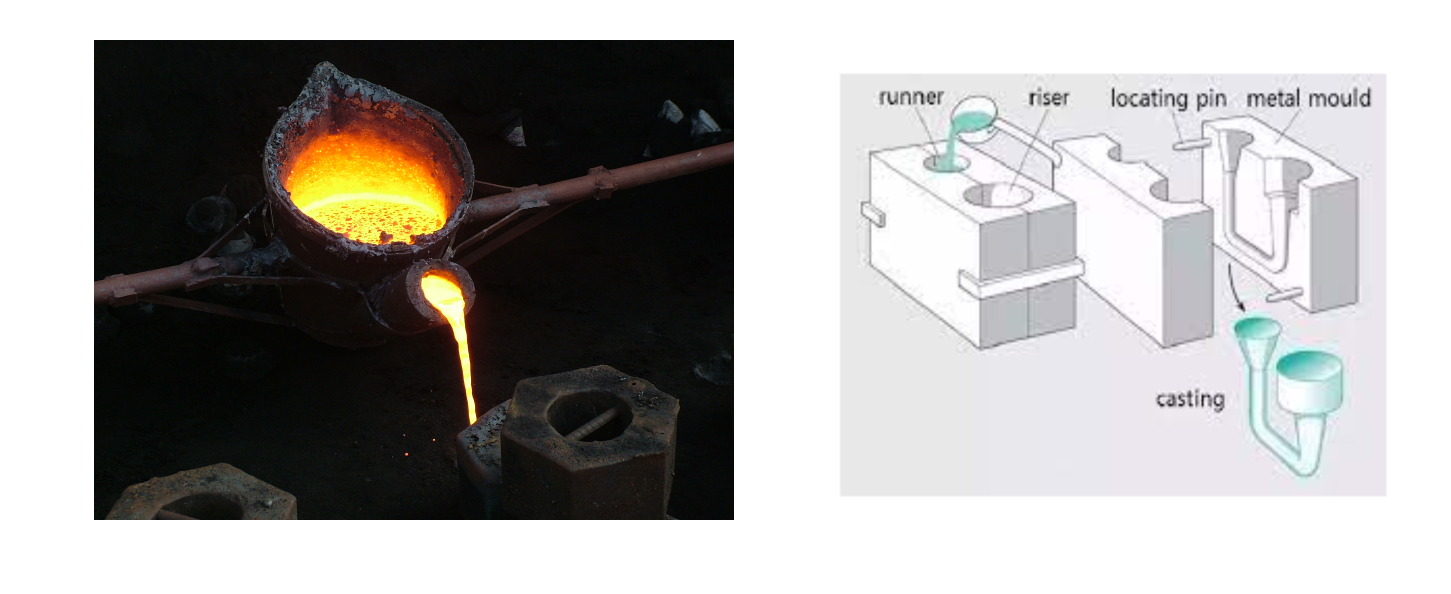 We can sort of do something similar in Java, but with Variable Types
| Images extracted from P Akthy and machinemfg
We can sort of do something similar in Java, but with Variable Types
| Images extracted from P Akthy and machinemfg
📚 Explicit & Implicit?
- Explicit: stated clearly and in detail, leaving no room for confusion or doubt.
- Implicit: implied though not plainly expressed.
Example Implicit Typecasting
public class Main {
 public static void main(String args[]) {
   int x = 10; // integer x
   // x is implicitly converted to float
   float z =x + 1.0f;
   System.out.println("x = " + x );
   System.out.println("z = 'x+1.0f'(x=10) = " + z );
 }
}
Output
x = 10
z = 'x+1.0f'(x=10) = 11.0
🧪 Try the code out!
Example Explicit Typecasting
public class Main {

public static void main(String args[]) {
  double d=1.6;
  int val=(int)d; //casting from double to int
  System.out.println("val = "+val );
  }
}
Output
val = 1
🧪 Try the code out!
🙋♂️ Analysis
- Why do you think that the code prints
1instead of1.6?
Typecasting might lead to loss of precision
In Implicit conversions, one data type is automatically converted into another if found compatible, but it should be in the right order else it may lead to loss of precision.
char->short-> int->float->double->long
Potential Errors When Typecasting
Avoiding Errors: This will throw you an error
public class Main {
 public static void main(String args[]) {
 int val=(int)2.4 - 2.1;
 System.out.println("val = " +val);
 }
}
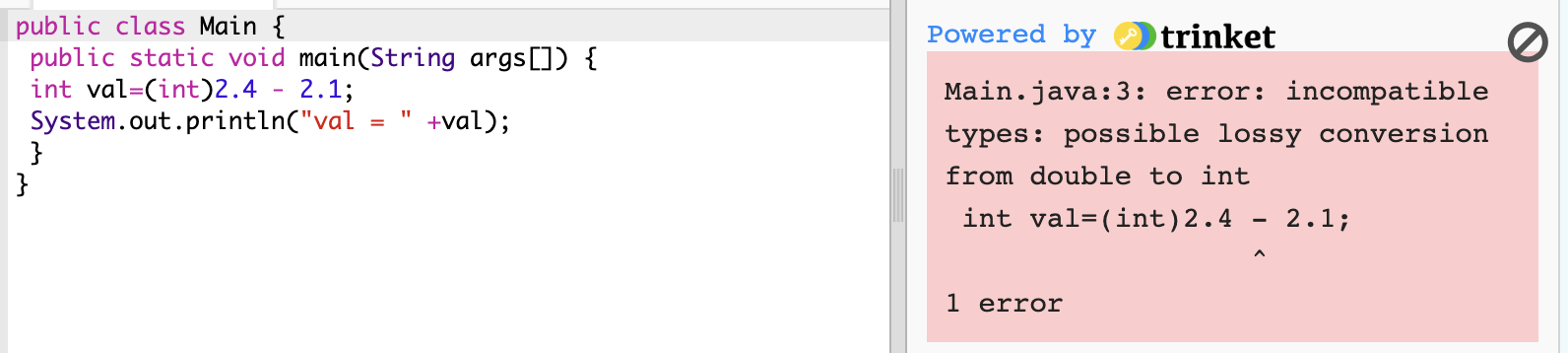
🧪 Try the code out! - This will throw an error
Do this instead
public class Main {
 public static void main(String args[]) {
 int val=(int)(2.4 - 2.1);
 System.out.println("val = " +val);
 }
}
🧪 Try the code out!
Try it: explicit casting
Typecasting
1 / 2int x = (int) 9.9; What is x?
int x = (int) 9.9;
Pick an answer to see if you are right.
Chapter summary
Key takeaways
- Implicit casting happens automatically when no data can be lost (
int→double). Explicit casting —(type) value— is required when data could be lost (double→int). - Casting a
doubletointtruncates toward zero; it does not round. - Wrap an expression in parentheses before casting it (
(int)(2.4 - 2.1)), otherwise the cast only applies to the first value, not the whole expression. - The safe widening order is
char → short → int → float → double → long; going the other way risks losing precision or overflowing.
Exercises
Activity: Round vs truncate
Read a double. Print two lines: the truncated int value ((int)), then the rounded value using Math.round.